
What Receipts Should Real Estate Agents Keep for Taxes?
Keep every receipt tied to your business — meals, marketing, dues, car costs, office supplies. A phone photo taken in the moment beats a shoebox of faded thermal paper every single time.
The keep-list, by category
If money left your hand (or your card) for your real estate business, keep the proof. Meals and coffee with clients, prospects, and colleagues — for the documentation business meals need, see the IRS's Publication 463 (Travel, Gift, and Car Expenses). Marketing: photography, staging, flyers, signs, online ads. Dues and fees: MLS, association, brokerage, license renewal, continuing education, E&O insurance. Car costs: gas, repairs, insurance, parking, tolls. Office: supplies, phone, internet, software subscriptions, home-office costs. Client gifts, with the recipient noted.
The test is simple: if you would want your CPA to see it, keep it. If you are unsure whether it qualifies, keep it anyway and let your CPA decide — an unclaimed receipt costs you nothing, but a missing one can cost you a deduction.
How long to keep them
Under current IRS guidance, you should generally keep records supporting your return for at least three years from the date you filed or the due date, whichever is later — longer in some situations, such as underreported income. The IRS explains the same on its recordkeeping page: you must keep records as long as needed to prove the income or deductions on your return. That sounds abstract until April of year four, when someone asks about year one. The practical rule: never throw away a business receipt. Digital storage is cheap; reconstructing a missing year is not. Confirm the right retention period for your situation with your CPA.
Why a phone photo beats the shoebox
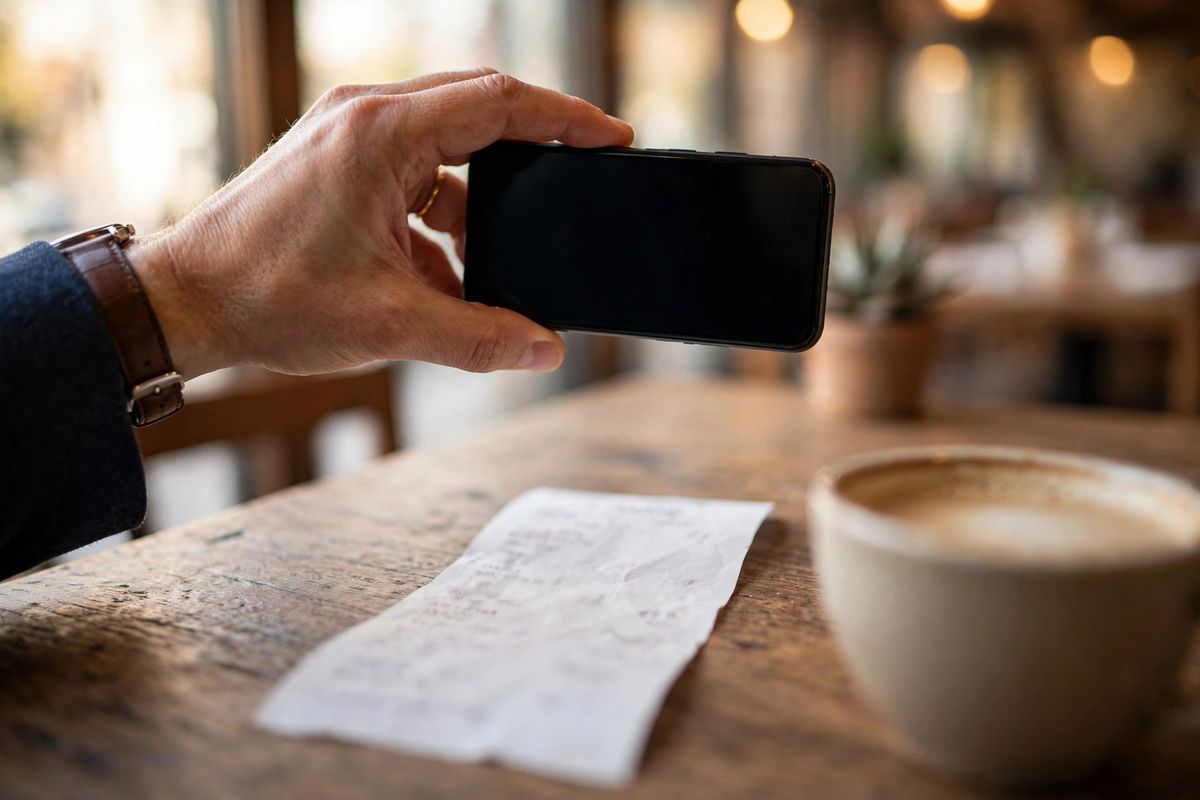
Thermal receipt paper fades — sometimes within months, especially in a hot car. A photo taken at the counter is timestamped, legible forever, and searchable. The habit is thirty seconds: snap the receipt, note what it was for and which client or property it relates to, and move on. Paper can go in the shoebox as backup; the photo is the record you will actually use.
Email confirmations and card statements help, but they rarely show what you bought or why. A card charge says "$48.00 — restaurant." A photo of the receipt plus your note says "Lunch with the Nguyen buyers — discussed offer strategy." Only one of those survives scrutiny.
The receipts agents throw away (but shouldn't)
Parking meters and garage tickets. Tolls. The $12 lockbox batteries. Printing at the office supply store. Mileage-adjacent costs like car washes before listing photos. Small cash tips related to business. None of these feel worth keeping, and collectively they add up to real money over a year. The smallest receipts are the ones most worth photographing, precisely because they are the ones you will never find again. For the routine that makes this automatic, see A Simple Receipt Routine for Busy Showing Days.
Organize as you go, not in April
A pile of 400 unsorted receipt photos is barely better than a shoebox. The fix is tagging at capture: category (meals, marketing, car), plus the property or client it relates to. "Photography — 123 Smith St" filed in March is useful; an untagged photo found in April is a puzzle. The IRS's Publication 583 (Starting a Business and Keeping Records) walks through building exactly this kind of recordkeeping system. When everything is tagged, your CPA handoff practically assembles itself.

Real agent questions
Do I need receipts for small cash expenses?
Yes — small cash expenses are the easiest to forget and the hardest to reconstruct. A quick photo and a one-line note at the time of payment is all it takes. Cash leaves no card trail, so your photo is the only proof the expense happened.
What if a receipt is already faded or lost?
Do not throw it away or invent a replacement. Keep what you have, note what you remember honestly (date, vendor, amount, purpose), and flag it as incomplete. Then confirm with your CPA how to handle it. One imperfect record disclosed honestly beats a clean-looking fabrication.
Are digital receipts and email confirmations enough?
They are good supporting evidence, especially for online purchases. But they often lack the business-purpose context — an email confirms you paid a photographer $350, not which listing it was for. Pair the confirmation with a note about the property or client, and you have a complete record.
How should I organize receipt photos?
By category first, then by property or client: meals, marketing, car, dues, office — each tagged to the listing or person it relates to. Organize at the moment of capture, not in a year-end marathon. Future you, handing a tidy export to your CPA, will be grateful.
Do I need to keep receipts for things my brokerage reimburses?
Keep them until the reimbursement clears, and keep a record of the reimbursement itself. If your brokerage reimburses you, the expense generally is not yours to deduct — but you want proof of both sides in case anything is questioned. When in doubt, keep it and ask your CPA.
What is the $75 rule I have heard about?
Under current IRS guidance, documentary evidence is generally expected for expenses of $75 or more, and always for lodging — but smaller expenses still need a record of amount, date, place, and business reason. The practical takeaway: photograph everything. The rule sets a floor for paperwork, not a permission slip to skip small receipts. Confirm current thresholds with your CPA.
Sources
- IRS — Recordkeeping for Small Businesses (what to keep, how long, burden of proof)
- IRS Publication 583 — Starting a Business and Keeping Records (building a recordkeeping system)
- IRS Publication 463 — Travel, Gift, and Car Expenses (business-meal documentation rules)
This article is educational and does not constitute tax advice. For questions about what you can deduct, check current IRS guidance or ask your CPA.
AgentDeduct is built for the thirty-second capture: log the expense while it's fresh, attach the receipt, tag the property. Get the app or open the web app to try it.
← Back to the Journal