
Can Real Estate Agents Claim the Home Office Deduction?

Often, yes — if part of your home is used regularly and exclusively for your real estate business. But "exclusive" means what it says, and that is where most agents get tripped up.
The short answer
Real estate agents are textbook candidates for the home office deduction: you are self-employed, and much of your actual work — contracts, calls, marketing, bookkeeping — happens at home between appointments. Under current IRS guidance, you can generally deduct expenses for the business use of your home if the space meets two tests: regular use and exclusive use. Meet them, document them, and the deduction is straightforward. Miss the exclusive-use test, and the most common outcome is no deduction at all — which is why understanding that one word matters more than anything else in this article.
The two tests: regular and exclusive use
Regular use means you use the space regularly for business — not once in a while, not only in a pinch, but as a genuine part of how you work. A desk where you write contracts three evenings a week qualifies; a corner you used twice during a busy month does not.
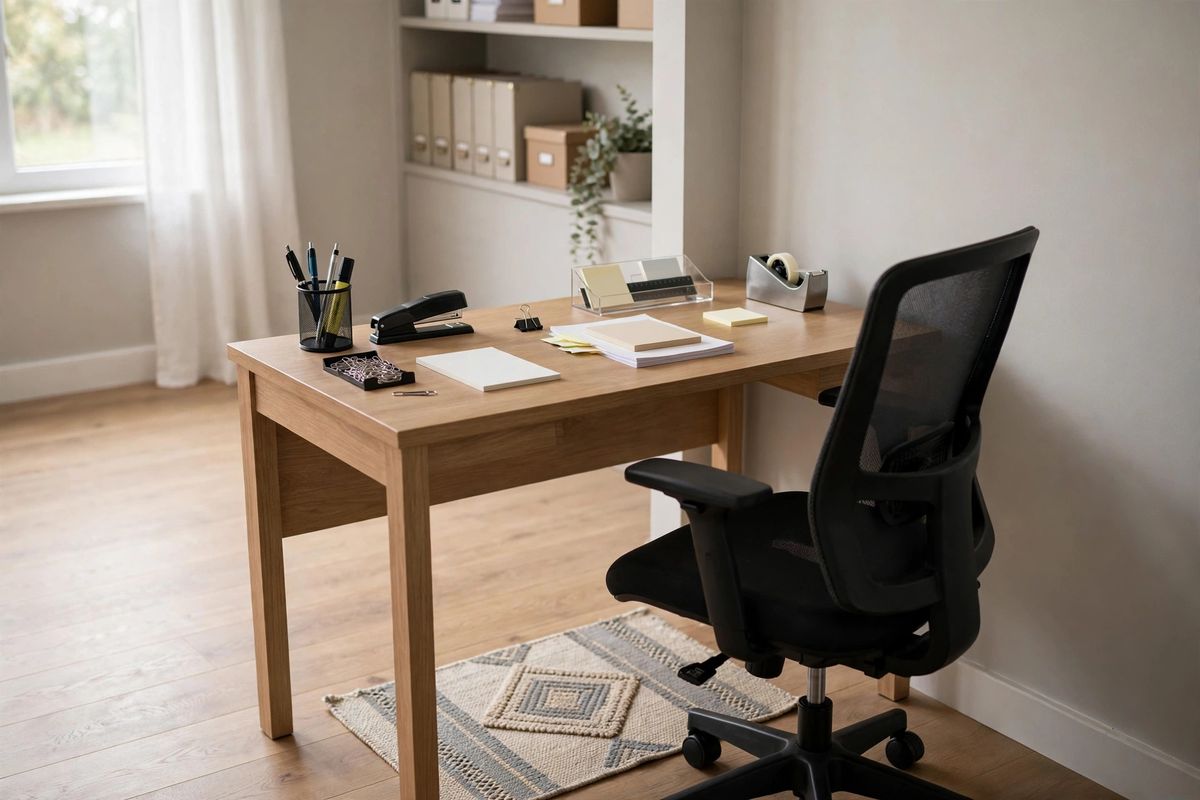
Exclusive use is the stricter test, and it means exactly what it says: the space must be used exclusively for business. A spare bedroom that is your office — and also the guest room, the kids' homework spot, and where the treadmill lives — fails the test. The space does not have to be a whole room; a clearly defined area used only for business can qualify. But "mostly business" is not exclusive. Walk through your space honestly: if anything non-business happens there regularly, it likely does not qualify. Confirm your specific setup with your CPA before claiming it.
Simplified method vs. actual expenses
You generally have two ways to compute the deduction. The simplified method gives you a set dollar amount per square foot of home office space, up to a cap — no receipts to track, no allocations to compute. The actual-expense method lets you deduct a share of real costs — mortgage interest or rent, utilities, insurance, repairs — apportioned by the office's share of your home's square footage.
The simplified method is easier and suits most agents; the actual method can yield more if your housing costs are high. You choose each year under current IRS guidance, so you are not locked in forever. The IRS explains both methods — including which expenses each covers — in its home office deduction guidance and in Publication 587 (Business Use of Your Home). Run both with your CPA and take the better answer — but whichever you choose, the regular-and-exclusive-use tests still apply.
The documentation that keeps it defensible
Three things, kept once and updated yearly. First, the measurements: your home's total square footage and the office area's square footage, with a simple sketch or photo showing the space. Second, evidence of regular use: your work patterns — contracts drafted, calls made, marketing built — tied to the space. Third, the expenses: utility bills, insurance, repairs, and rent or mortgage statements if you use the actual method.
Photograph the space once a year. It takes ten seconds and it answers the question "was this really an office?" better than any paragraph. Store it with your other tax records — see What Receipts Should Real Estate Agents Keep for Taxes? — and bring the whole file to your CPA handoff.

A common agent scenario
Picture this: you have a 1,800-square-foot home and a 120-square-foot spare bedroom set up as your office — desk, laptop, files, nothing else. You write contracts there four evenings a week and run your marketing from it. That space is used regularly and exclusively for your business. Under the simplified method, you would compute the per-square-foot amount times 120 (subject to the cap); under the actual method, you would apportion roughly 6.7% of eligible home costs. Either way, the deduction follows from the facts — which is exactly why documenting the facts is the whole game. Confirm the current figures and your eligibility with your CPA.
Real agent questions
Does my home office have to be a separate room?
No — it has to be a separately identifiable space used exclusively for business. A defined area of a larger room can qualify if nothing non-business happens there. What fails is a shared space: the kitchen table, the guest room, the corner of the living room that doubles as family space.
What if I also meet clients at a brokerage office?
That is fine and very common. The home office test is about how you use the home space, not about whether you ever work elsewhere. Many agents split time between a brokerage office, properties, and home — the home portion can still qualify if it meets the regular-and-exclusive tests on its own.
Can I claim the home office deduction if I rent?
Yes. Renters can generally claim it under either method — the actual-expense method apportions a share of your rent, while the simplified method does not depend on rent at all. The regular-and-exclusive-use tests apply the same way whether you own or rent. Confirm with your CPA.
What expenses can I include under the actual-expense method?
Generally a business-use share of mortgage interest or rent, utilities, homeowners or renters insurance, repairs and maintenance, and sometimes depreciation — apportioned by the office's share of your home's square footage. Direct office expenses (repairs to the office space itself) may be fully deductible. Your CPA should review the list before you file.
Will claiming a home office trigger an audit?
There is no public evidence that it does on its own. What draws attention is not the deduction but sloppy documentation — a spare bedroom claimed with no measurements, no photos, and mixed personal use. A well-documented, honestly-computed home office is unremarkable. Keep the file clean and stop worrying.
What if I only started working from home mid-year?
You generally claim it for the portion of the year the space met the tests — the simplified method, for example, is typically prorated by months of qualifying use under current IRS guidance. Document when the qualifying use began. Partial-year use is normal; just do not claim months before the space qualified. Confirm the computation with your CPA.
Sources
- IRS — Home Office Deduction (regular and exclusive use requirements, simplified vs. regular method)
- IRS Publication 587 — Business Use of Your Home (qualifying tests, figuring the deduction, records to keep)
This article is educational and does not constitute tax advice. For questions about what you can deduct, check current IRS guidance or ask your CPA.
AgentDeduct is built for the thirty-second capture: log the expense while it's fresh, attach the receipt, tag the property. Get the app or open the web app to try it.
← Back to the Journal