
What Does the IRS Require in a Mileage Log?

Under current IRS guidance, a mileage log should record four things for each business trip — the date, the destination, the business purpose, and the miles driven — and it should be recorded at or near the time of the trip. That is the entire requirement. Everything else in this article is about making those four fields a habit instead of a year-end panic.
For real estate agents, mileage is usually the single largest vehicle-related record on the return. You drive for a living: showings, listing appointments, inspections, closings, the supply run for lockbox batteries. Only the miles you can document count — a vague memory of "I drive a lot for work" is not documentation. Four fields, written down fresh, is.
The four fields, with agent examples
Date. The day the trip happened. Your phone already knows it; the point is tying the entry to a specific day.
Destination. Where you went, specific enough to mean something later: "123 Smith Street — showing." A year from now, the address still means something. "Showing" doesn't.
Business purpose. Why you went, in one honest sentence: "Buyer showing — the Nguyen family, second tour." This is the field agents skip most, and the one that turns a drive into a business trip on paper.
Miles. The distance for that trip, one-way or round trip — just be consistent. Your trip odometer, a mapping app, or a mileage app all work; precision to the mile is plenty.

What "contemporaneous" actually means
The word the IRS uses is contemporaneous: recorded at or near the time the trip happened. The IRS puts it plainly in its business-use-of-car guidance (Topic 510): the law requires you to substantiate your expenses with adequate records or sufficient evidence. In practice, that means the same day, or within the same week at the outside. A log filled in every evening — or an app that captures the trip as it happens — is contemporaneous. A log reconstructed the following April from a hazy memory and a calendar is not, even if every number in it happens to be right. Memory is not evidence: anyone can write down impressive numbers months later, and the discipline of recording them fresh is what makes the log believable.
Why rebuilding it in April is a gamble
Here's the uncomfortable truth: a log reconstructed at tax time carries less weight than one kept through the year, no matter how carefully it's done. If your return is ever questioned, "I rebuilt it from my calendar in April" invites scrutiny that "here's my log, kept daily" doesn't. Reconstructed entries also skew wrong in both directions — short trips get forgotten entirely, memorable ones get rounded up. Neither helps you.
If you're reading this in April with no log, don't fabricate one — a made-up log is worse than an incomplete one. Reconstruct what you can honestly support with your calendar and showing records, mark those entries as reconstructed, and ask your CPA how to handle the gaps. Then start a real log today.
The question every agent asks: home to the first showing
Commuting — home to your regular workplace — is generally not deductible under current IRS guidance. But most agents don't have one regular workplace, so a home-to-showing trip may count as business mileage depending on your facts: a qualifying home office, whether the brokerage office is your regular workplace, and how the trip fits your pattern. This is one of the most misunderstood areas in agent taxes — confirm your specific situation with your CPA before claiming these miles, then apply the answer consistently all year.
What else belongs with the log
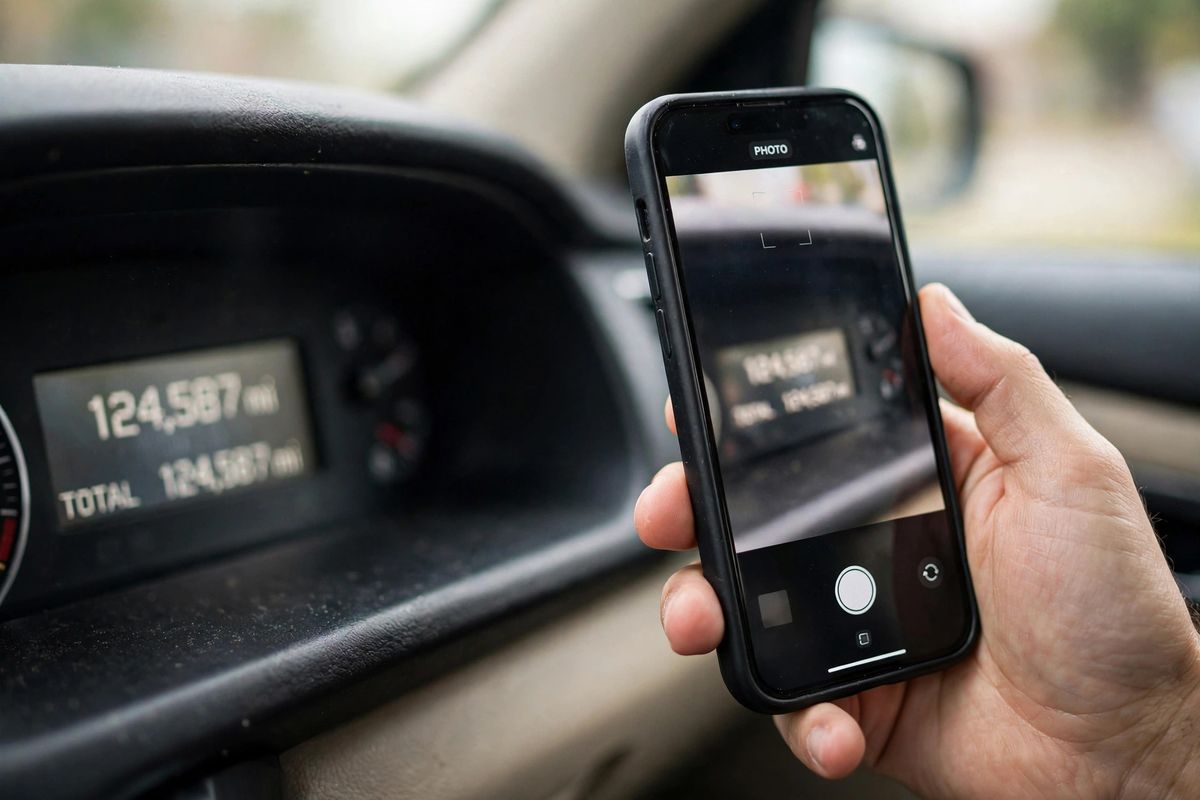
Two things that aren't part of the log but strengthen it: odometer readings at the start and end of the year — a dashboard photo every January 1st supports your annual total — and separate receipts for tolls and parking. Tolls and parking are their own expenses: keep the receipts, don't fold them into the mileage number. Under current IRS guidance they're generally deductible on top of the standard mileage rate; confirm with your CPA.
The two-minute habit
The agents with bulletproof logs aren't more disciplined than you — they just made capture instant. When the trip ends, record the four fields before you get out of the car: date, destination, purpose, miles. Two minutes, while it's fresh. An app that prompts you at the right moment makes it nearly automatic — that's what AgentDeduct's mileage capture is built for. For the broader picture of what agents forget to record, see The Small Business Expenses Real Estate Agents Forget to Record.
Real agent questions
What exactly goes in each mileage log entry?
Each entry should record four things: the date of the trip, the destination, the business purpose, and the number of miles driven. Under current IRS guidance, those four fields — recorded at or near the time of the trip — are what make a mileage log adequate. Confirm the details with your CPA.
Does my calendar count as a mileage log?
A calendar helps — it proves where you were and why — but it usually lacks the miles driven, which is one of the required fields. Many agents pair the two: the calendar supplies the appointment and purpose, and the log (or app) supplies the miles. Together they tell the complete story.
What if I forgot to log some trips?
Don't invent entries — a fabricated log is worse than an incomplete one. Reconstruct what you honestly can using supporting evidence like your calendar, emails, and showing records, and mark those entries as reconstructed. Then start logging fresh from today. Ask your CPA how to handle the gaps.
Do I need odometer readings?
Per-trip odometer readings aren't one of the four required fields, but start-of-year and end-of-year odometer readings are genuinely useful: they support your total mileage for the year and let your CPA sanity-check the business percentage. Take a photo of your odometer every January 1st — it takes ten seconds.
Can I use an app instead of a paper log?
Yes. What matters is the content — date, destination, business purpose, miles — and that entries are recorded at or near the time of the trip. Paper, spreadsheet, or app all count if the records are complete and timely. Pick whichever one you'll actually use every day.
Do tolls and parking go in the mileage log?
No — tolls and parking are separate expenses, documented with their own receipts, not folded into the mileage figure. If you use the standard mileage rate, tolls and parking are generally still deductible on top of it under current IRS guidance. Keep the receipts and confirm the treatment with your CPA.
Sources
- IRS Topic No. 510 — Business Use of Car (recordkeeping requirements: adequate records or sufficient evidence)
- IRS Publication 463 — Travel, Gift, and Car Expenses (what records you need to prove your expenses)
This article is educational and does not constitute tax advice. For questions about what you can deduct, check current IRS guidance or ask your CPA.
Mileage is the easiest record to lose and the simplest to keep — if capture happens in the moment. Get the app to log business drives the second they end.
← Back to the Journal