
How Do Realtors Track Business vs. Personal Car Use?
Your car is half office, half family vehicle — and the tax rules want to know exactly which half is which. The business-use percentage is the number that answers that question.
What the business-use percentage actually is
It is exactly what it sounds like: the share of your total driving that was for business. If you drove 20,000 miles in a year and 15,000 of them were for showings, listings, inspections, and other business purposes, your business-use percentage is 75%. That one number then apportions every car-related figure that needs apportioning — insurance, repairs, depreciation under the actual-expense method, and more.
Think of it as the key that unlocks the car deduction. Without it, you have a pile of car costs and no principled way to say which slice belongs to the business. With it, the math is clean and defensible.
How to compute it (it is just division)
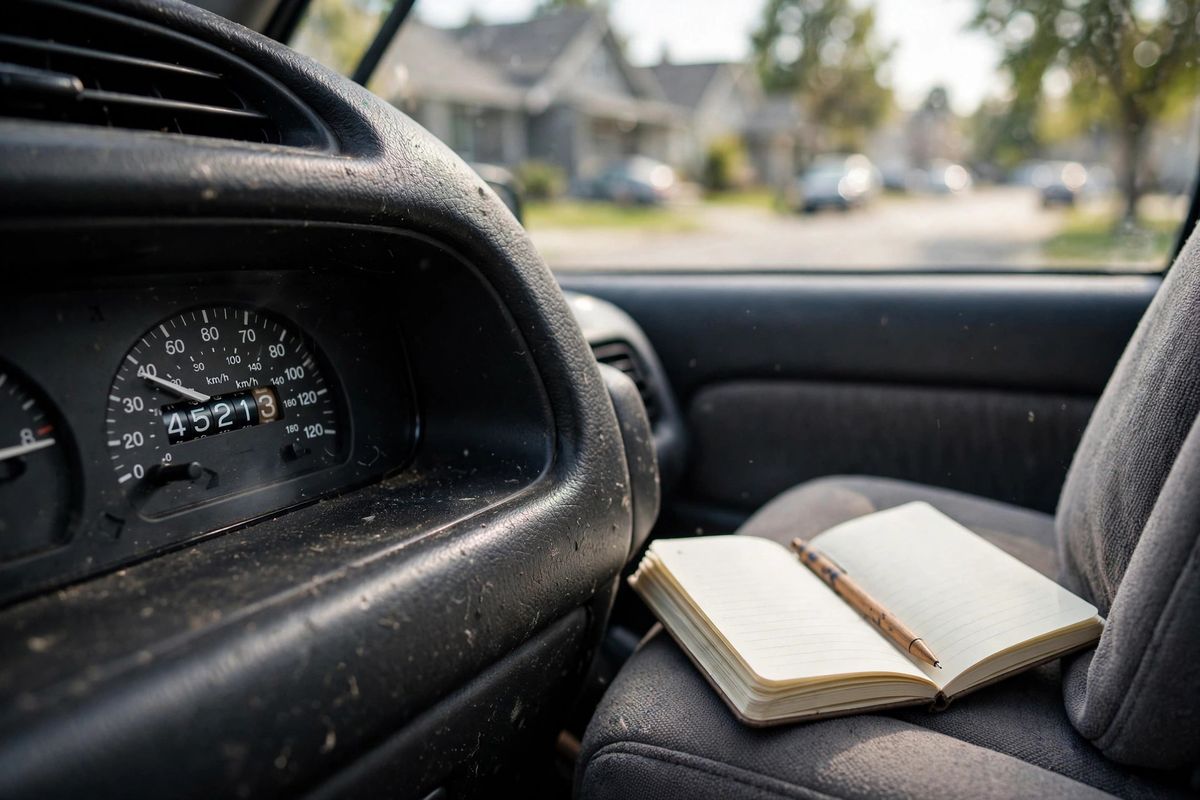
Step one: total miles for the year. Write down your odometer on January 1st and December 31st — that difference is your denominator, and it is the number most agents never capture. Step two: business miles for the year, from your mileage log — the numerator. Step three: divide business by total. That is your percentage.
The most common failure is a missing denominator. Agents who log business trips diligently but never record the odometer at year-start end up with a numerator and no denominator — and a percentage built on an estimated total is a percentage built on sand. Two odometer photos a year. That is the whole trick.

Where the percentage matters at tax time
The percentage shows up everywhere car-related. Under the actual-expense method, it apportions gas, insurance, repairs, and depreciation — the IRS explains the method in Topic 510 (Business Use of Car). It is also the number behind mixed-use questions your CPA will ask: the business share of your car insurance, the business share of a new set of tires, the business share of the car itself if you are depreciating it. Even agents using the standard mileage rate benefit from knowing it, because it disciplines the log — when business miles are 90% of total miles, something is usually off, and the percentage makes that visible.
Bring both totals to your CPA handoff: total miles and business miles, with the log behind them. Your CPA does the apportioning; your job is handing over numbers that reconcile.
Keeping the number honest
Three habits keep the percentage defensible. First, log personal miles by subtraction — you do not need to record every grocery run; total minus business equals personal, as long as the total is real. Second, be consistent: do not count the school run as business because you thought about a listing at a red light. Third, revisit the percentage yearly — a year with a new baby or a slow market changes the mix, and a stale percentage is a wrong percentage.
The agents who get in trouble here are not the ones with low percentages; they are the ones with suspiciously round ones. 75% computed from real totals is a record. 80% because it felt right is a guess. For the daily habit that feeds these totals, see A Simple Receipt Routine for Busy Showing Days and Can Real Estate Agents Deduct Mileage to Showings?.
Real agent questions
What counts as a business mile?
Any mile driven for a business purpose: showings, listing appointments, inspections, closings, trips for supplies or signage, drives to meet clients or colleagues. Commuting to a fixed regular workplace is generally not included. When a trip mixes purposes, use your best honest judgment about the primary purpose and note it.
Do I need to track personal miles too?
Not trip by trip. If you know total miles (odometer readings) and business miles (your log), personal miles are the difference. What you cannot do is know business miles and guess the total — the denominator has to be real for the percentage to mean anything.
What if I use two cars?
Track each vehicle separately — its own odometer readings, its own business miles, its own percentage. Do not blend them into one number. Your CPA will want the per-vehicle breakdown, especially under the actual-expense method where costs differ by car.
Can I estimate the percentage, or does it have to be exact?
It has to come from real numbers: actual odometer readings and an actual log of business miles. A percentage pulled from memory or rounded to a tidy number is not a record. Estimates are what you use when records are missing — and missing records are the problem you are solving.
Does commuting lower my business-use percentage?
Commuting miles count as personal miles in the calculation, so yes — regular commuting lowers the percentage. This is another reason the home-to-first-showing question matters so much for agents; get the characterization right with your CPA, because it moves the number.
What records should I keep to support the percentage?
Two odometer readings (start and end of year), a contemporaneous log of business miles with dates, destinations, and purposes, and receipts for vehicle expenses if you use the actual-expense method. That is the complete file. Everything else is commentary.
Sources
- IRS Topic No. 510 — Business Use of Car (standard mileage rate vs. actual expenses, business-use apportionment)
- IRS Publication 463 — Travel, Gift, and Car Expenses (recordkeeping requirements)
This article is educational and does not constitute tax advice. For questions about what you can deduct, check current IRS guidance or ask your CPA.
AgentDeduct is built for the thirty-second capture: log the expense while it's fresh, attach the receipt, tag the property. Get the app or open the web app to try it.
← Back to the Journal